Cave Explorer Safety Beacon - 🏆 1st place at CU Hacking 2026 (QNX stream)
A cave explorer carries Rocko, a handheld device running on a Raspberry Pi 5 under QNX 8. It listens for a spoken emergency, classifies it on device with TFLite, and sends the result through solid rock to the surface using a low frequency magnetic field, the same principle real mine rescue beacons use. A photo based injury classifier runs on the same device for cases where a camera feed is available. A surface station (a quantum tunneling TMR sensor wired to a Pico, plugged into a laptop) decodes the signal and shows what happened, when.
Every few minutes the device also sends a heartbeat, so if the pings stop arriving, the surface knows something is wrong even if no emergency was ever spoken. Silence is the alarm.

 |
 |
| Last minute LARP sesh before judging | The team, after judging |
Watch the demo on YouTube - wake phrase to on-device classification to a frame decoded at the surface.
The whole loop, from spoken word to surface alarm:
flowchart TD
    subgraph EXPLORER [Explorer device, Pi 5 on QNX]
        STT[USB mic, whisper.cpp] --> GATE{wake phrase<br>hey rocko help?}
        GATE -->|no, keep listening| STT
        GATE -->|yes| CLS{classify the speech}
        CLS -->|fire, trapped, lost, injured| FLAGS[set the matching flags]
        CLS -->|phrase alone or unclear| SOS[SOS, all four flags]
        CLS -->|clear all-okay, no distress| CANCEL[cancel pending alert]
        CANCEL --> STT
        CAM[camera photo] --> INJ{injury image classifier<br>CNN, 8 wound classes}
        INJ -->|injured| FLAGS
        FLAGS --> TX[coil transmitter<br>3 repeats, 3 s gaps]
        SOS --> TX
        TIMER([120 s timer]) --> HB[heartbeat frame, all flags zero]
        HB --> TX
    end
    TX -->|8 Hz Manchester tone, through rock| ADC
    subgraph SURFACE [Surface station, laptop and Pico]
        ADC[TMR quantum sensor, Pico ADC] --> DEC[bandpass, preamble lock, decode]
        DEC --> LOG[dashboard, numbered event log]
        DEC --> WD[watchdog, expects a heartbeat]
        WD -->|none in time| ALARM[raise the alarm<br>silence is the alarm]
    end
Two fail-safes are baked into the gate: emergency content always outranks the cancel word, and negated or unclear speech is never read as an all clear, it falls through to SOS.
EXPLORER DEVICE (Raspberry Pi 5, QNX 8, battery powered)
  USB mic --> whisper.cpp --> wake phrase gate --> classifier --> transmitter
  photo   --> TFLite injury model (8 wound classes)
  GPIO22/17/27 --> L298N driver --> coil --> through rock --> surface sensor

SURFACE STATION (laptop, no second Pi)
  TMR quantum sensor --> Pico (ADC, 200 samples/sec) --> USB serial --> laptop
  laptop: live 3 pane dashboard, decoder, numbered event log

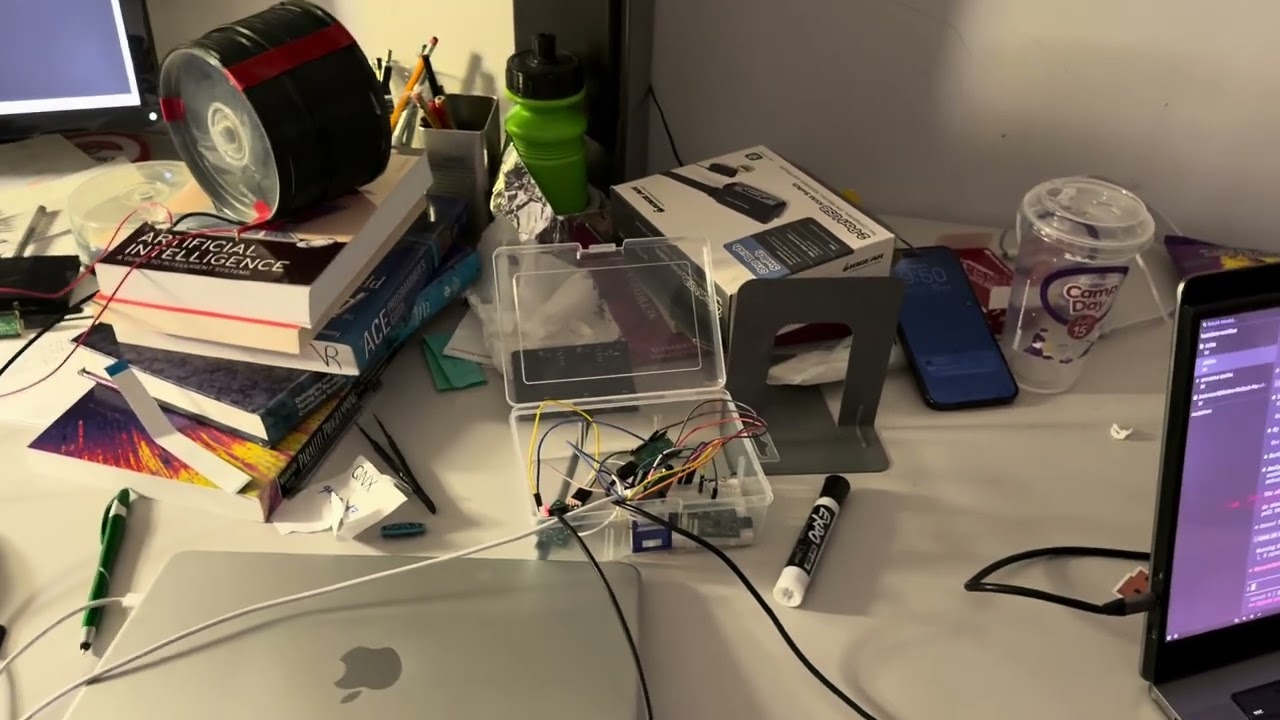
The rig on the bench: the hand wound coil, the Pi in its enclosure on the right, and the surface dashboard locked onto a frame mid decode, with QNX on the monitor behind.
Wake phrase: "hey rocko help", followed by what happened. Saying the phrase alone sends an SOS. Saying "hey rocko help, I am okay" cancels a pending alert. The wake gate is a single choke point in the code: nothing transmits before a real classification happens, and unclear or negated speech never gets read as a false all clear.
Frame format: an 8 bit preamble (01111110) followed by 4 flag bits,
sent with Manchester encoding on an 8 Hz tone, 1 second per bit. Emergencies
repeat 3 times with 3 second gaps for reliability. A heartbeat (all flags
zero) goes out automatically every 120 seconds. The full code table lives in
docs/equipment-codes.md, this is the contract
between the explorer side and the surface decoder.
Explorer device, on the Pi over SSH:
sh rocko.shOne command starts the audio pipeline and the coil transmitter together, with
a numbered, timestamped event log on screen. sh rocko.sh photo <image>
classifies a wound photo instead, using the on-Pi TFLite model by default.
To run Said's in-repo PyTorch CNN instead (its trained model ships in
CNN/outputs/, needs pip install -r CNN/requirements.txt):
ROCKO_PHOTO_BACKEND=cnn sh rocko.sh photo <image>Surface station, on the laptop:
pip install -r receiver/requirements.txt
python3 receiver/rocko_receiver.py
The dashboard auto-detects the Pico's serial port, shows both sensors raw, the 8 Hz filtered signal, and the carrier amplitude with an adaptive threshold. Decoded frames get a marker and a numbered log entry.
TTS/-- wake phrase gate, emergency classifier (C, compiled on the Pi), live listener script, built by Amr (@Amrooosh)transmitter/-- coil transmitter daemon, frame encoding, GPIO backendphoto/-- injury photo classifier (TFLite)CNN/-- standalone injury image classifier: PyTorch training, evaluation, and prediction over 8 wound classes, built by Said Elakad (@saidel04)receiver/-- surface capture, live dashboard, decoderbench/-- early hardware bring up scripts and the CNN training scriptdocs/equipment-codes.md-- the frozen frame contract, both sides build against thisdocs/adr/-- why key hardware and protocol decisions were madedocs/plan/-- product requirements, architecture, and build notesdocs/images/-- photos of the build and the eventtests/-- unit tests for the transmitter, receiver, wake gate, photo classifier, and launcher
- Explorer device: one Raspberry Pi 5, QNX 8, USB microphone, L298N motor driver wired to a hand wound coil. GPIO22 to IN3, GPIO17 to IN4, GPIO27 to ENB, coil on OUT3/OUT4. 12 V only touches the L298N, grounds are shared.
- Surface station: a TMR (tunnel magnetoresistance) magnetic sensor, a genuinely quantum detector. Electrons tunnel through a nanometer thin insulating barrier between two ferromagnetic layers, and the tunneling resistance tracks the magnetic field, so the beacon is literally read through quantum tunneling. Wired to a Raspberry Pi Pico (ADC digitizer), USB serial to a laptop. No second Pi.
See docs/plan/ARCHITECTURE.md for the full
wiring diagram and signal chain.
How much signal actually survives the rock? A separate bench rig answers that: a transmitter that sends known symbols (A to Z) through the coil, and a coded receiver that decodes them, so link quality is measured instead of assumed. This is instrumentation, not the beacon. The emergency path is the 12 bit frame described above.
Across 30 frames at five transmit duty cycles:
| Duty | Pooled SNR | Layered decoder | Coherent SLNN |
|---|---|---|---|
| 100% | 3.37 dB | 5/6 | 6/6 |
| 50% | 4.72 dB | 5/6 | 6/6 |
| 25% | 0.18 dB | 3/6 | 6/6 |
| 10% | no positive estimate | 0/6 | 0/6 |
| 1% | -29.49 dB | 0/6 | 0/6 |
The coherent SLNN decoder holds 6/6 down to 0.18 dB, where the simpler layered decoder falls to 3/6. Below 10% duty nothing decodes. On held out frames the SLNN generalized on 3 of 5, including one at -2.42 dB when the scheduled frame boundary was supplied.
Caveat recorded with the run: people walked across the link during some frames and those frame identities were not logged, so this is a mixed clean and interference dataset rather than a controlled sweep.
The rig, the decoders, and the full results live on the task/receiver-v2
branch (results),
built by Mohammad Steitieh.
python3 -m pip install numpy scipy
python3 -m unittest discover -s tests
97 tests, no hardware required. The receiver tests decode synthetic waveforms, the transmitter tests run against a simulation backend.
Proprietary, all rights reserved. Visible for evaluation and judging only.
No permission is granted to use, copy, modify, or distribute this work.
See LICENSE.