Summary
Hangul lines are broken at syllable boundaries. Word breaks at eojeol
(space-delimited word) boundaries on ordinary lines and only falls back to
character-level breaking to keep a justified line from going too loose. The
result is that a Korean word is split across two lines where Word moves the
whole word down.
Neither w:wordWrap nor w:kinsoku appears in the source, and settings.xml
carries only compatibilityMode=15, so Word's defaults are in force.
This is Word-specific behaviour, not a general CJK rule: PowerPoint itself
breaks Korean mid-word, and office2pdf's PPTX output matches PowerPoint's break
points exactly on the same corpus.
Measured
tests/golden_mocks/business/sources/docx/02_contract_ko.docx, page 1:
| paragraph |
Word |
office2pdf |
| 제1조 line 1 ends / line 2 begins |
…필요한 제반 사항을 / 정함을 목적으로 한다. |
…사항을 정 / 함을 |
| 제4조 line 1 ends / line 2 begins |
…VAT 별도)으로 / 하며, 을은… |
…으로 하 / 며, 을은… |
One syllable (10.5pt) migrates in each case.
Word was not out of room. On 제1조 the trailing space of Word's line 1 ends at
507.99pt and "정" would end at 518.49pt, well inside the 524.47pt right margin —
Word had 6pt of space and still moved the whole word down. Line width: Word
493.80 vs office2pdf 508.11.
The trigger shows up in the same file's two justified paragraphs
(<w:jc w:val="both"/>): there Word does break mid-eojeol, and identically to
office2pdf (both split 보관|한다.). So character-level breaking is Word's
fallback for justified lines, not its default.
Corroborated across every wrapped body paragraph of an internal test document,
where office2pdf breaks 제공하는 → 제 / 공하는, 지원하는 → 지원하 / 는,
발화량 → 발 / 화량, 발생할 → 발생 / 할 and 103,125 / 원 while Word breaks at the
space each time. That is not a metrics difference: matched wrapped lines agree
to ≤0.1pt, both sides use a 70.8pt left margin and the same 453.6pt text width,
and the constant 3.7pt difference on paragraph-final lines is Word's trailing
space glyph.
Reproduction
cargo run --release -p office2pdf-cli -- \
    tests/golden_mocks/business/sources/docx/02_contract_ko.docx -o out.pdf
Compare the line endings of 제1조 and 제4조 against Word.
Expected
On a non-justified line, a Hangul eojeol is treated as an unbreakable unit: 제1조
line 1 ends at "…제반 사항을" and 정함을 begins line 2 whole.
Actual
Every syllable boundary is a break opportunity, so the last word of the line is
split and one syllable is left behind on the line above.
Found in the 2026-07-29 full-corpus visual audit at c1adfbd (native Office GT, 150 DPI, mutool-trace geometry).
Visual comparison
| Compare |
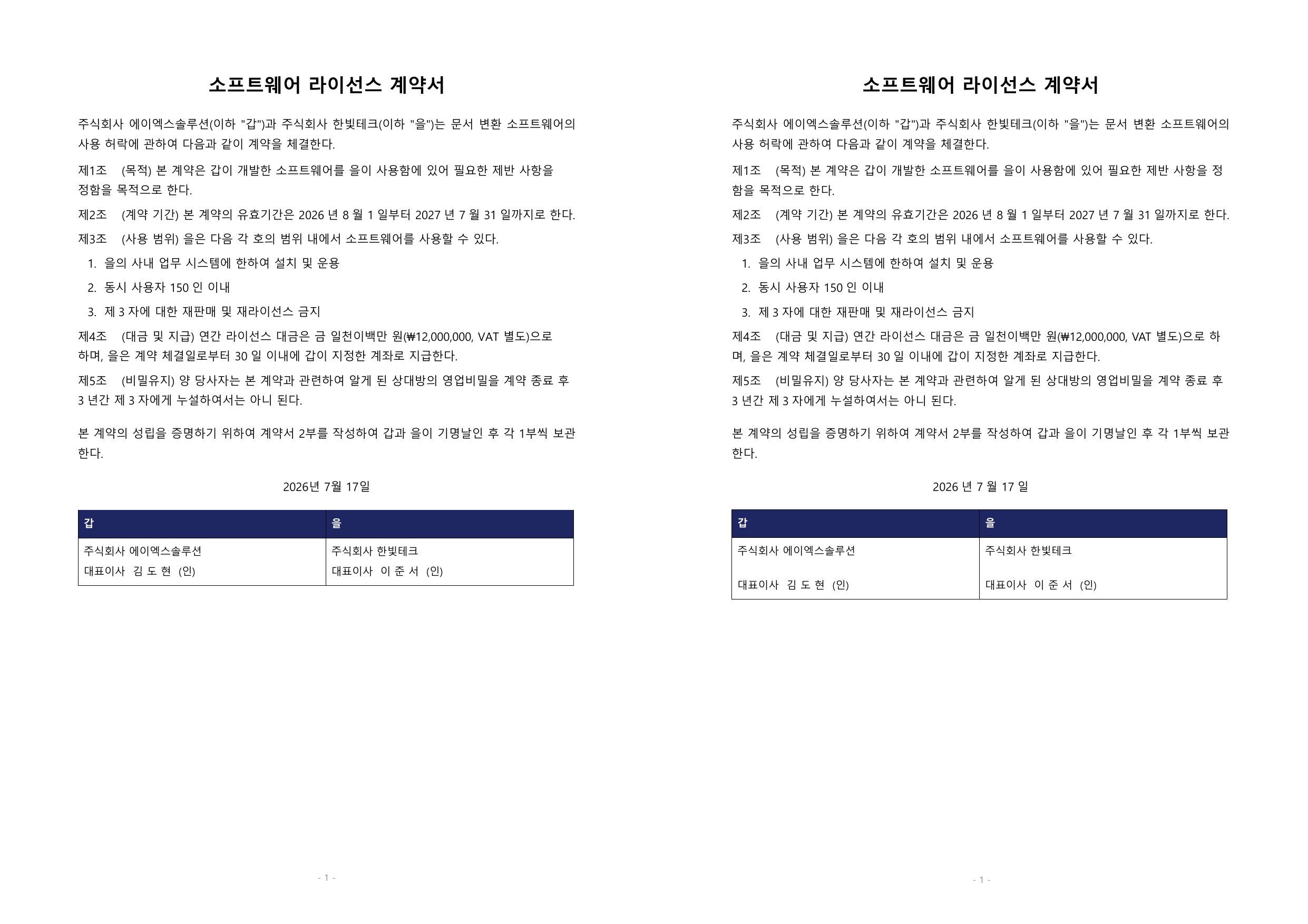 |
GT left, office2pdf right, 150 DPI, same page.
Summary
Hangul lines are broken at syllable boundaries. Word breaks at eojeol
(space-delimited word) boundaries on ordinary lines and only falls back to
character-level breaking to keep a justified line from going too loose. The
result is that a Korean word is split across two lines where Word moves the
whole word down.
Neither
w:wordWrapnorw:kinsokuappears in the source, andsettings.xmlcarries only
compatibilityMode=15, so Word's defaults are in force.This is Word-specific behaviour, not a general CJK rule: PowerPoint itself
breaks Korean mid-word, and office2pdf's PPTX output matches PowerPoint's break
points exactly on the same corpus.
Measured
tests/golden_mocks/business/sources/docx/02_contract_ko.docx, page 1:One syllable (10.5pt) migrates in each case.
Word was not out of room. On 제1조 the trailing space of Word's line 1 ends at
507.99pt and "정" would end at 518.49pt, well inside the 524.47pt right margin —
Word had 6pt of space and still moved the whole word down. Line width: Word
493.80 vs office2pdf 508.11.
The trigger shows up in the same file's two justified paragraphs
(
<w:jc w:val="both"/>): there Word does break mid-eojeol, and identically tooffice2pdf (both split
보관|한다.). So character-level breaking is Word'sfallback for justified lines, not its default.
Corroborated across every wrapped body paragraph of an internal test document,
where office2pdf breaks 제공하는 → 제 / 공하는, 지원하는 → 지원하 / 는,
발화량 → 발 / 화량, 발생할 → 발생 / 할 and 103,125 / 원 while Word breaks at the
space each time. That is not a metrics difference: matched wrapped lines agree
to ≤0.1pt, both sides use a 70.8pt left margin and the same 453.6pt text width,
and the constant 3.7pt difference on paragraph-final lines is Word's trailing
space glyph.
Reproduction
cargo run --release -p office2pdf-cli -- \ tests/golden_mocks/business/sources/docx/02_contract_ko.docx -o out.pdfCompare the line endings of 제1조 and 제4조 against Word.
Expected
On a non-justified line, a Hangul eojeol is treated as an unbreakable unit: 제1조
line 1 ends at "…제반 사항을" and 정함을 begins line 2 whole.
Actual
Every syllable boundary is a break opportunity, so the last word of the line is
split and one syllable is left behind on the line above.
Found in the 2026-07-29 full-corpus visual audit at c1adfbd (native Office GT, 150 DPI, mutool-trace geometry).
Visual comparison
GT left, office2pdf right, 150 DPI, same page.